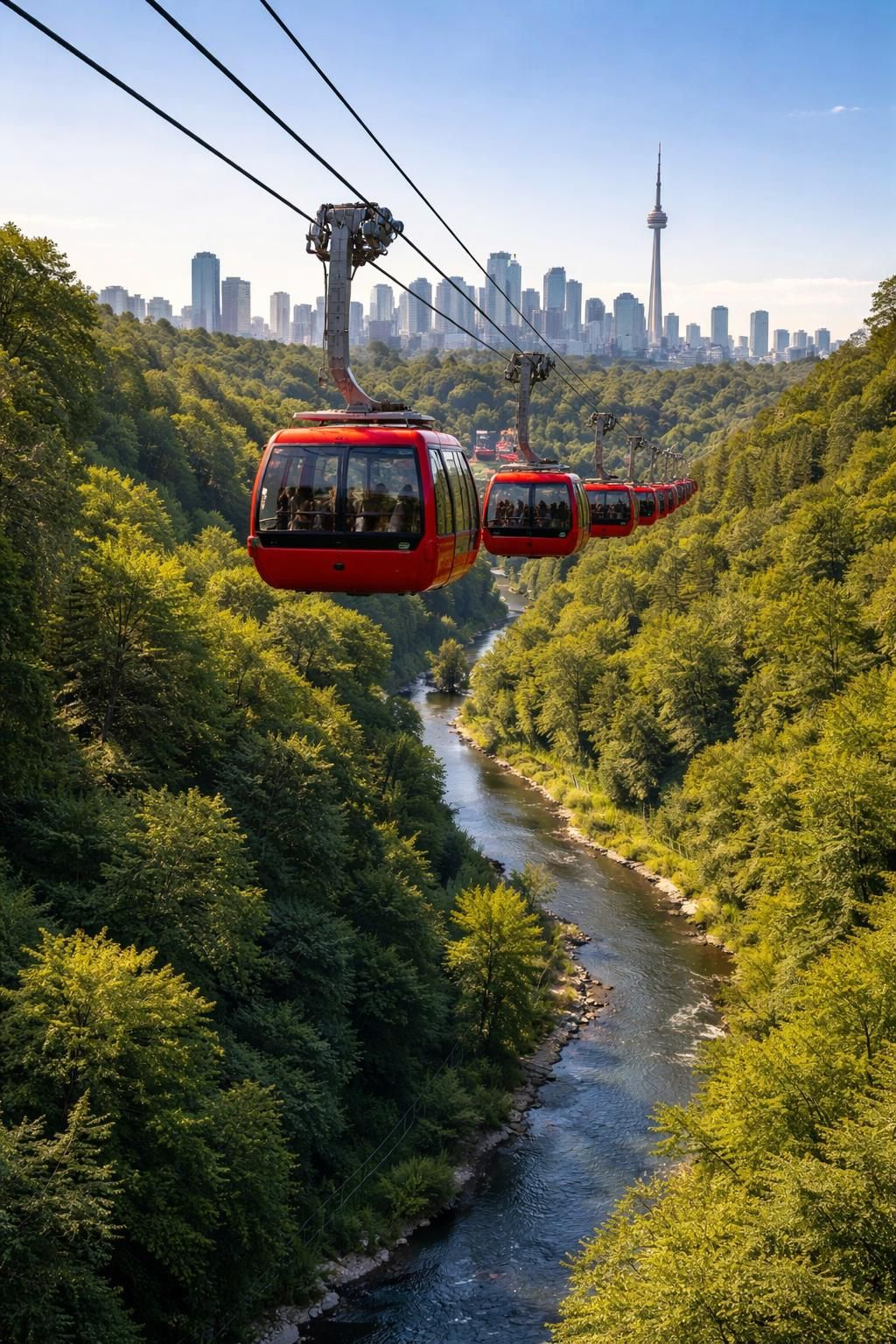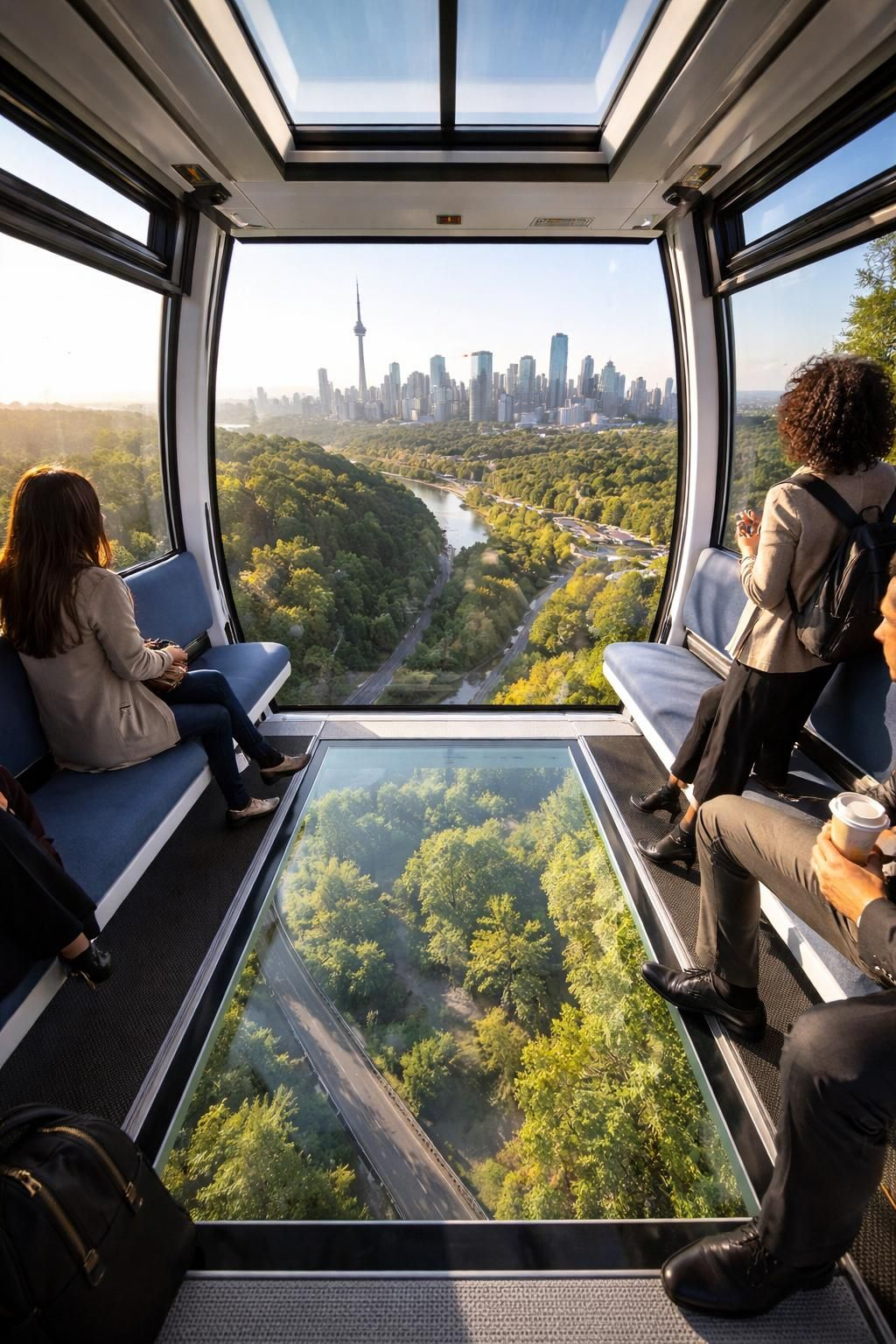
Toronto is a city perpetually in pursuit of better movement. We debate subways, LRTs, busways and bike lanes with a kind of civic intensity usually reserved for playoff hockey. Yet as congestion deepens and costs soar, perhaps it is time to look up—literally. Imagine a gondola sky car mass transit line gliding down the Don Valley from Newmarket to the waterfront: a quiet, elegant ribbon in the sky, offering commuters not only speed and reliability but a daily moment of wonder.
Urban gondolas are no longer novelties confined to ski hills. Systems in cities such as Medellín and La Paz have demonstrated that aerial cable transit can move thousands of passengers per hour safely, efficiently and affordably. Modern gondola cabins are enclosed, climate-controlled, wheelchair accessible and continuously circulating, meaning minimal wait times. They are engineered to operate in high winds and harsh weather, and their safety records rival—if not exceed—many traditional transit modes.
Toronto’s Don Valley presents a rare geographic opportunity. Stretching like a green artery from the northern suburbs to Lake Ontario, it already functions as a natural transportation corridor, home to rail lines, the Don Valley Parkway and multi-use trails. A gondola line could follow this path with remarkably light infrastructure: slender, very tall poles spaced roughly every 100 yards to support the cables, plus thoughtfully designed stations at key nodes. Compared to the tunneling, expropriation, utility relocation and years-long street closures associated with projects like the Eglinton Crosstown LRT or the under-construction Ontario Line, an aerial system would be far less disruptive and dramatically cheaper.
Cost matters. Subway construction in North America now routinely runs into the hundreds of millions of dollars per kilometre. By contrast, gondola systems are typically a fraction of that amount. They require no deep excavation, no complex underground stations and no massive concrete guideways. Installation can be measured in months rather than decades. In a city where transit timelines stretch across election cycles and beyond, speed of delivery is itself a virtue.
Capacity is often raised as an objection, yet modern tricable gondola systems can move up to 5,000 passengers per hour per direction, comparable to some light rail lines. Crucially, a Don Valley gondola would not replace subways; it would complement them. By offering an alternative north-south route, it could relieve pressure on the chronically overcrowded Line 1 Yonge–University, particularly during peak hours. Commuters from York Region and northern Toronto could transfer seamlessly to stations along the valley, bypassing bottlenecks at Bloor-Yonge and Union.
Then there is the experience. Transit should not merely be endured; it can inspire. A gondola ride above the Don’s forests and river would feel like a magic carpet commute, a suspended journey through autumn colours, winter snowfalls and spring blossoms. Instead of staring at tunnel walls, riders would watch the city unfold beneath them. Such daily beauty has civic value. It fosters pride and connection to place.
Environmental benefits add another layer of appeal. Gondolas are electrically powered and relatively quiet, with a small ground footprint that preserves much of the valley’s ecology. By drawing drivers off congested roads, they could reduce emissions and help Toronto meet its climate goals.
Bold ideas often begin as sketches in the margins. A Don Valley gondola may sound unconventional, but so once did subways themselves. As Toronto grows, it must embrace solutions that are imaginative, practical and fiscally responsible. Sometimes the smartest way forward is to rise above the problem—and let the city see itself from a new height.