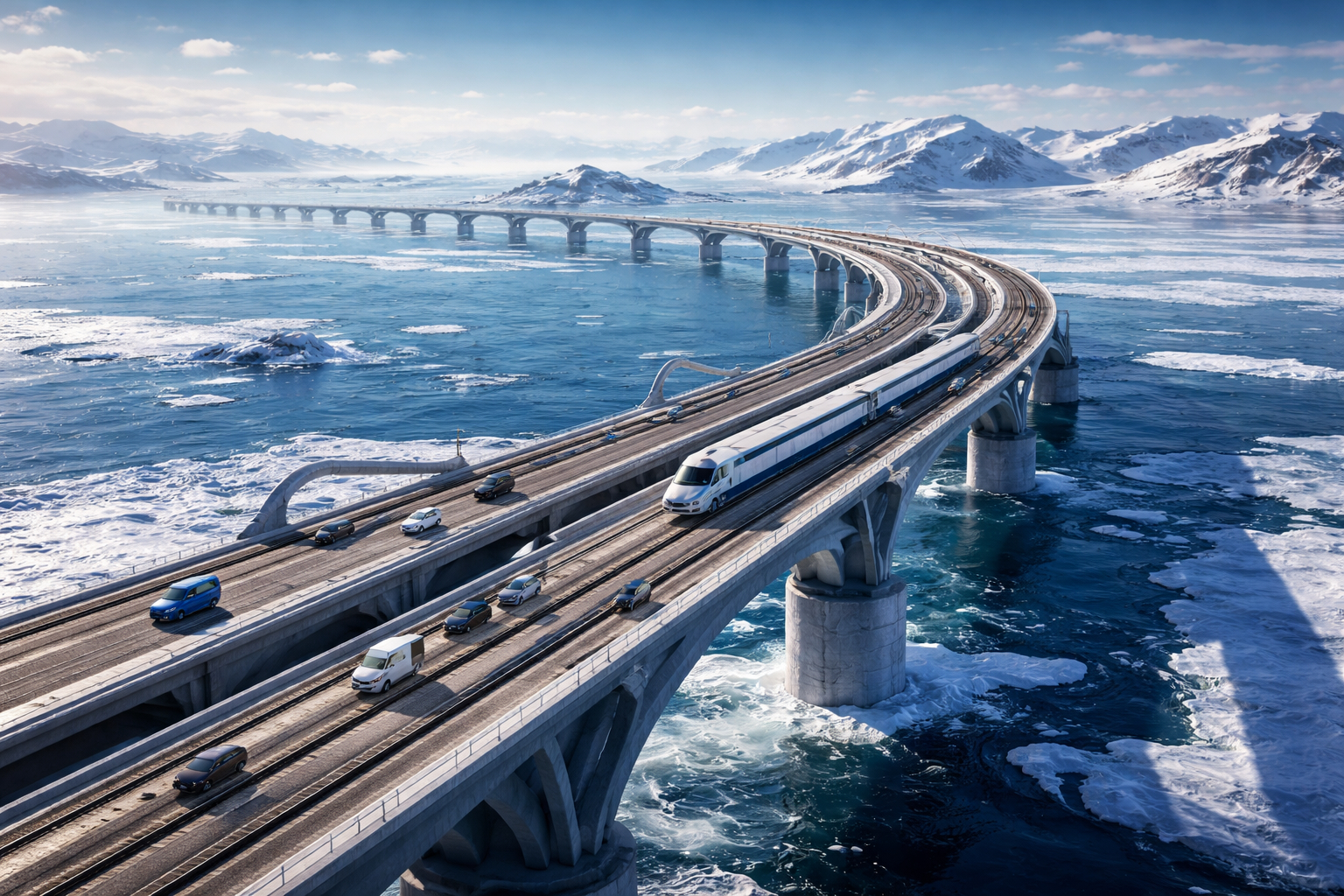
There are few places on Earth that feel as symbolically charged as the Bering Strait — that narrow, icy ribbon of water separating Alaska from Russia. For most of human history, it has been a boundary: between continents, between empires, between political systems. Yet geographically it is astonishingly small. At its narrowest point, the gap between North America and Asia is roughly 85 kilometres. On a globe, it is barely a seam.
What if, instead of a seam, it became a stitch?
The idea of a bridge spanning the Bering Strait has long hovered at the edges of visionary infrastructure thinking. Technologically, it is no longer fantasy. Engineers have already solved the challenge of building in hostile, ice-choked waters. The Confederation Bridge — stretching 12.9 kilometres across the Northumberland Strait — stands as proof. Its ice-shielded piers are shaped to deflect and break up moving sea ice, allowing the frozen masses to fracture and flow around the structure. When it opened in 1997, many doubted such a structure could survive Canadian winters. It has done so reliably for decades.
Scale that ingenuity up. The Bering Strait contains two stepping stones — the Diomede Islands — that could divide the crossing into shorter segments. A multiform structure could combine bridge spans, submerged floating tunnels, and reinforced causeways. Built for resilience, designed for modular expansion, and powered by renewable energy harvested from Arctic winds and currents, it would not merely connect two shores. It would connect the world.
Because the true magic lies beyond the bridge itself.
For the first time in history, humanity could construct a continuous, around-the-world land artery — a modern Pangaea Highway. Imagine driving from New York across North America, through Alaska, over the Bering Strait, across Siberia, and onward to Moscow, Paris, or London. Imagine heading south from Toronto to the tip of South America without ever boarding a ship. The children in the back seat would ask, “Are we there yet?” and you could smile and say, “Just one more continent to go.”
But this vision is far more than a road trip fantasy.
The crossing could be designed as a multi-modal corridor: electrified high-speed rail lines, freight tracks, autonomous vehicle lanes, hydrogen pipelines, fibre-optic cables, and even water transfer conduits. In a century increasingly defined by supply chain fragility, such a terrestrial artery would add resilience to global trade. Instead of routing so much of the world’s goods across vulnerable maritime chokepoints, cargo could move by electrified rail across continents. Oil and gas pipelines — or in time, green hydrogen networks — could reduce reliance on tanker traffic through crowded seas.
An electrified global highway could also accelerate the transition to clean transportation. Heavy freight, one of the hardest sectors to decarbonize, could shift toward continuous electric rail spanning Eurasia and the Americas. Charging infrastructure embedded in the corridor could support long-range electric trucking. Renewable power generated in remote northern regions could be transmitted along the route to population centres thousands of kilometres away.
Beyond economics and energy, there is a deeper civilizational implication. For millennia, oceans have divided cultures. A permanent land connection between North America and Eurasia would symbolize something profound: that geography no longer dictates separation. Trade, tourism, scientific collaboration, and cultural exchange would gain a tangible, physical backbone. It would be difficult to view another continent as abstract or distant when you could, in principle, drive there.
Skeptics will raise legitimate concerns: cost, environmental impact, Arctic fragility, geopolitical tension. These must be confronted honestly. Any project of this magnitude would demand international cooperation on an unprecedented scale. Environmental safeguards would need to be rigorous, protecting marine ecosystems and Indigenous communities. The corridor could not be imposed; it would have to be collaboratively shaped.
Yet history shows that bold infrastructure often reshapes what seems possible. The transcontinental railways stitched together vast nations. The Channel Tunnel joined Britain and France beneath the sea. The Confederation Bridge overcame ice and doubt. Each was once dismissed as impractical.
The Bering Strait crossing would be the next leap — not merely a bridge, but a planetary backbone. A 21st-century Silk Road built not for empire, but for interdependence.
In an era when global headlines often emphasize division, perhaps the most radical act would be to build something that literally unites continents. A structure that says the distances between us are smaller than we think. A highway where the horizon is not the end of the world, but the beginning of another one.
And somewhere, years from now, a family might pack the car, glance at a world map, and choose a direction — not because they must, but because they can.